

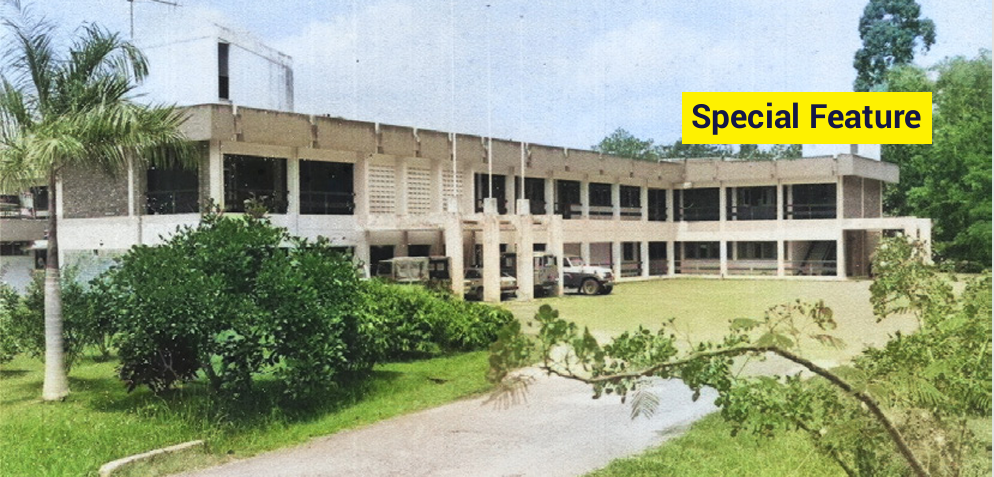
FRC Building in the 1980’s.
In its simplest form, ‘research’ can be defined as the process of uncovering facts and information to enhance our understanding of a specific subject. Throughout the various stages of the Sabah Forestry Department’s development since its establishment in 1914, research has consistently played a vital role in the department.
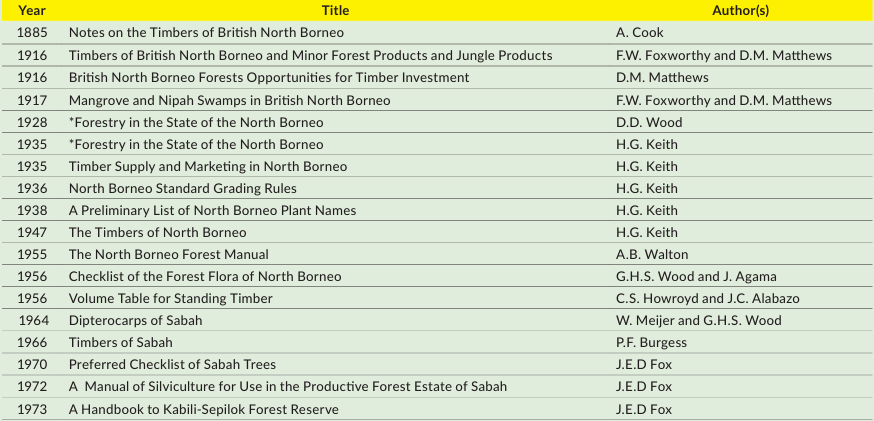
*Although they have the same title, the papers were presented by different authors in different conferences: The Empire Forestry Conference in Australia and New Zealand (1928) and The Fourth British Empire Forestry Conference in South Africa. Some of the books, forest records, and working papers were prepared in the early days from the late 1880s to the 1970s.
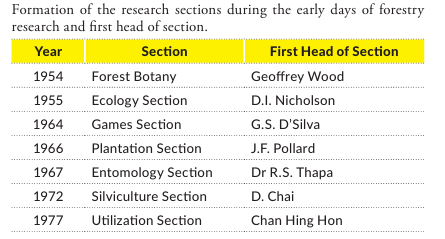
The first documented research in forestry dates back to 1880, when Franz Witti conducted a scientific study of the Gaya Island forest. From the 18th century through the late 1970s, the primary focus of forestry was on timber concessions; therefore, it is of no surprise that most research undertaken at that time was on topics specifically related to the timber trade. Occasionally, one can come across records on subjects such as botanical explorations, the copal industry, freak storms, and others. Despite the challenges posed by periods of war in between, more than 200 publications were produced during that time. Some of the publications are listed in the table above.
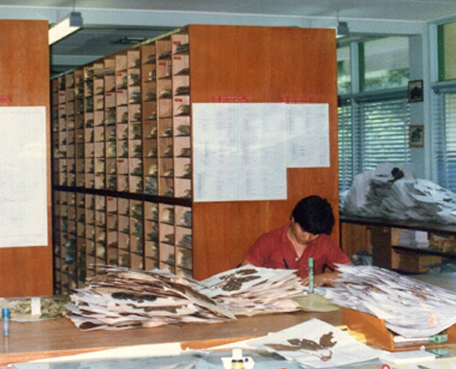
Botany staff processing herbarium specimens in the old FRC building in the 1980s.
Botanical exploration and collection by the department began as early as 1915, by A. Villamil and F.W. Foxworthy. In 1916, E.D. Merrill, the appointed botanist at the Bureau of Science in Manila, visited and recognized the importance of establishing a herbarium in Sandakan. This initiative eventually led to the creation of the herbarium during the tenure of D.M. Matthews as Conservator of Forests in 1916. When government officials questioned W. Meijer regarding the value of the botanical explorations and collections, he wisely emphasized that educating locals in forestry, particularly in forest regeneration, would be impossible without the knowledge and ability to identify the local flora. After World War II, forestry research expanded beyond the focus on the timber trade; instead, it included a variety of other fields, leading to the establishment of specialized research sections. With the completion of the Forestry Headquarters in Sandakan in 1962, the idea of setting up a Forest Research Centre (FRC) and training school complex began to take shape. The purpose of this complex was to promote and expand existing research areas, covering multiple facets of forest science, to ensure that information could be applied to forest management and industrial development, while simultaneously providing training for forestry staff.
In the words of Datuk Haji H.S. Martyn, the first locally appointed Conservator of Forests: “The timber industry which is fed by our forests has been playing a great economic role in the State for so many years now and will continue to be so for many years to come. Our forests therefore need planning and control to ensure the continuity of their economic role. Unlike other natural resources, forests can be renewed and having harvested their riches, it is a moral duty as caretakers of our forests to have them renewed for the benefit of our future generation. The continuity of our forest to be of economic value has been achieved by intensive research in Silviculture and allied subjects. By no means however research on this field is complete, therefore research on this field will have to continue.” (Excerpt of Speech at the Opening for the Forest Research Centre and Forest Training School, 27th October 1974)
In 1967, it was decided to position the complex next to the Kabili-Sepilok Forest Reserve. This location was selected due to its close proximity to a forest that had long been a site of continuous research and established ecological plots. Additionally, the Department’s Game Section had set up a station within the forest in 1964 specifically for orangutan rehabilitation. Other key factors in the decision included its easy accessibility to Sandakan and the minimal land acquisition required, as the site was adjacent to the forest reserve, thus avoiding additional costs associated with land acquisition.
Work on the forest research centre began in 1972 with the construction of a two-storey building to house the various sections that had been established. The building was completed in August 1974, during the Second Malaysia Plan, at a total cost of RM 865,000. Notably, the building utilized a variety of timber species in its structure, including Agathis, Ramin, Selangan Batu, Pauh Kijang, Sepetir, Merbau, Impas, Belian, and others. Exploring the different parts of the building itself became a learning experience. Additionally, 250 acres of land was gazetted to create an arboretum to supplement the dried collection in the herbarium. The vision for the arboretum was for it to eventually evolve into a Botanical Garden, offering a recreational space for the people of Sandakan.
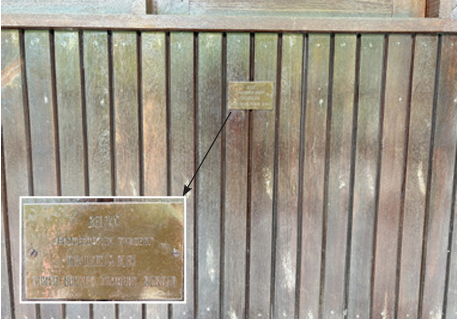
Belian panelling along the corridor outside of the office of the Deputy Chief Conservator of Forests (R&D). The timber material was donated by North Borneo Timbers Bhd.
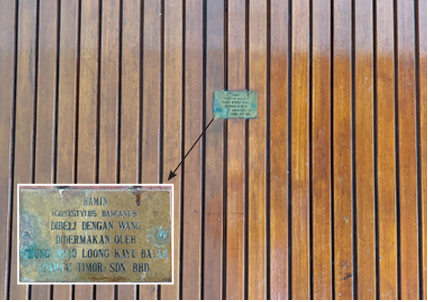
Ramin panelling on the 1st floor of the FRC 1974 building. Material purchased with donation from Chung Chao Loong Kayu Balak (Pantai Timor) Sdn. Bhd.
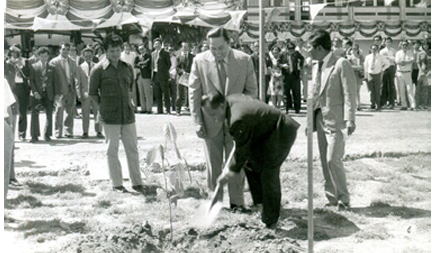
Tree planting after the opening ceremony of FRC by Y.A.B. Tun Datu Haji Mustapha bin Datu Harun accompanied by Conservator of Forests, Datuk Haji H. S. Martyn in 1974.
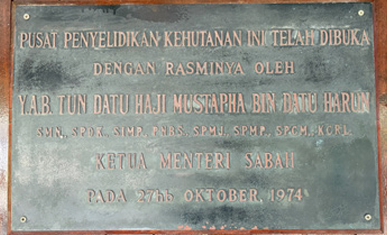
The FRC building was officially opened by the Chief Minister in 1974, Y.A.B Tun Datu Haji Mustapha bin Datu Harun.
The Forest Research Centre (FRC) and Forest Training School complex were officially opened by the Chief Minister of Sabah, Tun Datu Haji Mustapha bin Datu Harun, on October 27, 1974. The event coincided with the 5th Malaysian Forestry Conference, which was being held in Sabah at the time. By 1980, a research sawmill was incorporated into the FRC complex with proposals underway for further expansion to include the addition of a drying kiln and preservation plant.
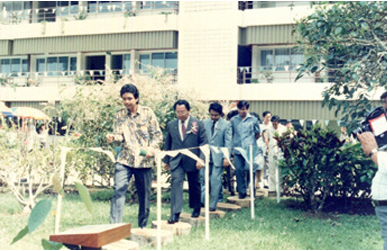
Opening of FRC 2 & 3 storeyed building by the Chief Minister, Y.A.B. Datuk Joseph Pairin Kitingan in 1989.
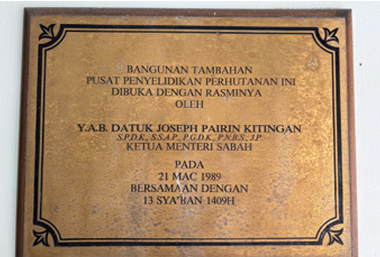
The 2 & 3 storeyed building was opened by the Chief Minister in 1989, Y.A.B. Datuk Joseph Pairin Kitingan.
The establishment of the FRC complex, with its ample space and robust infrastructure, has provided the foundation for research to grow beyond traditional fields such as botany, ecology, silviculture, plantation management, utilization, and entomology. As times changed, the scope of research gradually broadened to include new areas such as soils, wood technology, seed science, chemistry, tree improvement, agroforestry, ethnobotany, and conservation.