

Our Vision & Objectives
Strategies
In line with the vision and objectives of the Sabah Forestry Department, numerous strategies have
been identified to address current forestry issues, especially those relating to the ITTO Year 2000
Objective.
These strategic lines of action are as follows:

• Declare sufficient areas to be included in the Permanent
Forest Estate (PFE);
• Ensure that no part of the PFE is degazetted except
under extreme circumstances, in which case the
excised area should be replaced; and
• Identify State land areas which are suitable for inclusion
into the PFE.

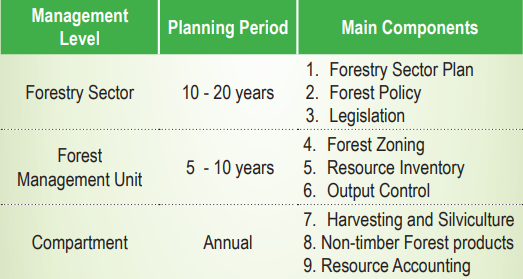
• Ensure that forestry planning follows the 3-tiered
approach as shown in the table below:
• Place the PFE under sustainable forest management
(SFM) in line with ITTO’s Year 2000 Objective, so that
the socioeconomic and environmental benefits from
the forests are maintained in perpetuity;
• Extend the Deramakot forest management planning
model to all the other Commercial Forest Reserves in
Sabah;
• Implement SFM in all forest management units, each
of which should comprise at least 100,000 ha of
commercial forest;
• Ensure that the management plans for all FMUs are
completed with the appropriate prescriptions for field
implementation.

• Permanent Forest Estate
In implementing SFM, the Government issues longterm license agreements in accordance with Section
15(1) of the Forest Enactment 1968. This agreement
will require the licensee to manage the FMU for a period
of 100 years according to the following conditions:
- The FMU is managed according to the conditions
of the licence agreement;
- The licensee submits a performance bond of RM 5
million;
- A management plan is prepared and approved;
- A requirement of at least 30% Sabah Bumiputra
participation in the company;
- Employ environmentally friendly harvesting
methods such as reduced-impact-logging (RIL) and
skyline yarding;
- Carry out silviculture and enrichment planting as
required;
- Employ professional foresters with experience; and
- The licensee shall bear all costs of forest
management planning and implementation.
• Stateland and alienated land
- Issue extraction license for state land or alienated
land according to Section 24 of the Forest
Enactment 1968 and other relevant government
policies; and
- Ensure the optimal use of forest resources on state
land and alienated land.
• Existing licenses
- Renew forest licenses only for state and alienated
land areas;
- Renewal of licenses for relogging within forest
reserves will be gradually stopped; and
- Long-term concession licenses will be reviewed
and incorporated into the implementation of SFM

• Promote efficient production through systematic
management planning, and resource development so
as to reduce damage to the forest environment;
• Ensure the optimal use of forest resources by
encouraging proper and systematic harvesting and log
production;
• Ensure that forest revenue corresponds to the
production capacity of the forest resources so as
to contribute towards sustainable socio-economic
development; and
• Ensure the systematic and efficient collection of royalty
and other charges on forest produce.

Ensure that the Forest Enactment 1968 and the Forest
Rules 1969 are constantly updated and fully enforced
to support the successful implementation of sustainable
forest management through the following:-
• Set up a committee headed by the State Attorney
General to review the forestry legislation every 6
months;
• Propose to the Ministerial Committee on Forest Policy
any necessary amendments to the legislation;
• Establish and strengthen enforcement teams in all
forestry districts;
• Intensify special operations against illegal forestry
activities with assistance from the Police and Army;
• Take disciplinary action against Forestry Department
personnel who are found to be involved in forestry
offences; and
• Seek assistance from the Federal Government to
address problems related to the involvement of
foreign workers involved in forestry offences so that a
diplomatic solution can be achieved.

Take a proactive approach in the protection of the State’s
Permanent Forest Estate, such as to:-
• Demarcate forest reserve boundaries on the ground;
• Take urgent steps to upgrade the capability of the
Department in forest fire prevention and control, with
emphasis on preventive measures;
• Curb illegal shifting cultivation activities in forest
reserves and relocate those involved parties to areas
designated for community forestry programmes; and
• Promote the voluntary practice of forest protection and
conservation by private land owners.

• Encourage licensees to conduct forest rehabilitation
in logged areas as required under the SFM license
agreement;
• Intensify rehabilitation measures in forest reserves
of low productivity through enrichment planting and
appropriate silvicultural treatments. On poor and
degraded forest areas, plantation forestry should be
introduced.
• Promote forest plantation development through the
active participation of the private sector; and
• Provide appropriate incentives in order to create a
conductive investment environment to encourage
developers to venture into plantation forestry.

Due to the declining timber resource, the wood industry
cannot rely on a sustainable supply of timber at previous
high levels from the State’s forests. The development of
the industry should instead focus on adaptive measures
such as to:
• Adjust the industry’s capacity according to the available
timber resources;
• Increase processing efficiency in order to reduce
wastage;
• Restructure the industry with emphasis on integrated
wood processing towards the production of valueadded items of export quality;
• Increase the competitive ability of the industry in terms
of cost and resource utilization; and
• Raise environmental awareness among mill operators
by introducing ‘green certificates’ in the issuance and
renewal of mill licences.

Despite the declining forest resource, the Department will
strive to increase revenue, by focusing on the following:
• Allow the export of logs in order to increase Government
revenue and improve the local market price for timber;
• Ensure that the administration of the export of logs and
other forest produce remain under the jurisdiction of
the State Government;
• Encourage log imports in order to fulfil the requirements
of the local wood industry;
• Devise marketing information systems to coordinate
wood supplies and request of the State in order to
reflect its current price in the market.

The Forestry Department has to foster close cooperation
with relevant local and national government agencies in
order that all the State’s forest development plans can be
carried out effectively, most importantly in the following
aspects:
• Environmental Conservation;
• Integrated Land Development;
• Forest Rehabilitation Programme;
• Wildlife Management and Conservation;
• Research and Conservation of Biodiversity; and
• Law Enforcement.

• Promote the participation of the private sector in the
implementation of sustainable forest management by
providing appropriate incentives;
• Assist and guide the private sector, especially the
Sustainable Forest Management License Agreement
holders so that they may play a more important role in
the development of the forestry sector; and
• Assist the private sector in preparing themselves for
the implementation of sustainable forest management.

• Promote the participation of Bumiputra entrepreneurs
in the wood industry, in line with government policy;
• Assist Bumiputra entrepreneurs on matters related to
the management of the wood industry; and
• Ensure the success of Bumiputra entrepreneurs in the
wood industry by providing the appropriate incentives
or mechanisms. These include advising less able
entrepreneurs to form a consortium.

• Enhance the level of forestry training for forestry
workers in both the private and government sectors;
• Upgrade the Forestry Training Institute as a centre of
excellence for forestry training;
• Ensure that the private sector’s workforce is fully
trained in the implementation of sustainable forest
management;
• Facilitate and expedite the training process for the
private and government sectors by developing “Core
Trainees”, who will become the principal forestry
trainers;
• Prepare a document or training programme for the
implementation and monitoring by the private and
Government Sectors; and
• Identify training needs and prepare, as well as update
training programmes by periodic consultations with the
private sector.

• Enhance the credibility of the Department’s
programmes and activities through the participation of
NGOs;
• Encourage the participation of NGOs in the
implementation of sustainable forest management
through consultancies and committees;
• Organise forums to discuss and resolve current issues.

• Continue efforts towards sustainable forest
management by seeking technical advice and guidance
from the relevant international agencies;
• Identify future co-operation, in line with the Department’s
goals and objectives; and
• Seek financial assistance from foreign sources for
forestry research and development.

• Review programmes of community forestry projects to
ensure that they are in line with traditional community
forestry concepts;
• Identify village communities living within the forest
reserves, through socio-economic studies, to ensure
that local community needs are addressed in the
preparation of forest management plans;
• Ensure that allocations from the Community Forestry
Development Fund are used for the implementation of
activities recommended in forest management plans;
and
• Foster close co-operation with other government
agencies in relation to providing basic amenities for
village communities.

• Review existing research programmes so as to ensure
that they contribute towards the implementation of
sustainable forest management;
• Enhance research related activities to the conservation
of the environment, biodiversity and non-wood forest
resources; and
• Encourage the participation of the private sector in
forestry research.

• Identify potential areas for outdoor recreation and
nature tourism;
• Provide recreational amenities and eco-tourism
facilities throughout the state;
• Formulate appropriate policies to support eco-tourism
development in forest reserves; and
• Ensure that eco-tourism development in forest reserves
is in line with the principles of sustainable forest use.

The role of the Forestry Department as the custodian of
Sabah’s forest resources and as a revenue generator
should be maintained. In view of this, the administration
of the Department should be strengthen and modernised
to keep abreast with current development by the following
means;
• Forestry Department
- Reduce “red tape” and bureaucracy in its
administration;
- Form a special task force to overcome the problem
of bureaucracy and “red tape”;
- Capacity building of the Forest Department;
- Improve information technology facilities in
administration and forest management, most
importantly by establishing computer networking
between all forestry offices in Sabah;
- Ensure adequate funds are allocated for forest
management; and
- Restructure the Forestry Department and introduce
“corporate concepts” in administration and
management.
• Ministerial Committee on Forest Policy
- Support the implementation of the State’s forestry
policies and strategies.


